

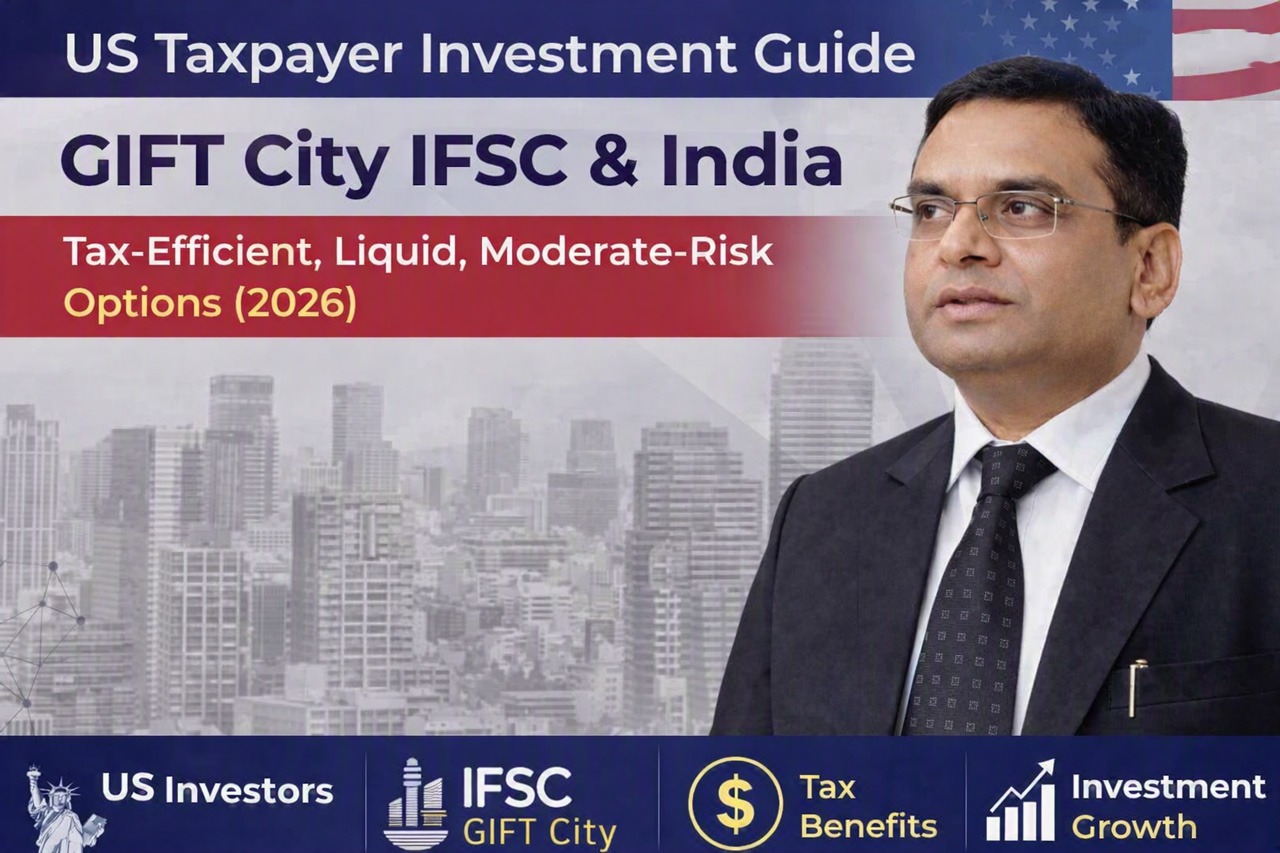
A United States taxpayer — whether a US citizen, Green Card holder, or resident alien — investing in India’s emerging global financial hub faces a fundamentally different tax, legal and operational landscape than Non-Resident Indians (NRIs) domiciled in tax-neutral or low-tax jurisdictions such as the UAE, Qatar, Singapore or the UK. Marketing narratives around Gujarat International Finance Tec-City (GIFT City) prominently feature “tax-free” returns and a long tax holiday for qualifying entities, but this exemption applies almost exclusively at the Indian domestic level. The Internal Revenue Service (IRS) exercises worldwide tax jurisdiction over US persons under Section 61 of the Internal Revenue Code (IRC), taxing global income regardless of where it is earned or whether it is exempt in the source country.
This structural misalignment creates a major cross-border friction point: the Zero-Foreign Tax Credit (Zero-FTC) Trap. Under the India-US Double Taxation Avoidance Agreement (DTAA), US taxpayers typically use taxes paid in India as a Foreign Tax Credit (FTC) on Form 1116 to offset their US federal tax liability. But when a GIFT City investment vehicle is fully exempt from Indian withholding or income tax, no foreign taxes are paid — so the available FTC drops to zero, and the full, un-offset tax burden shifts directly to the IRS. Separately, investing in pooled foreign funds within GIFT City — retail mutual funds and corporate-structured Alternative Investment Funds (AIFs) — triggers the US Passive Foreign Investment Company (PFIC) regime under IRC Sections 1291–1298, exposing investors to punitive taxation, compounding interest charges, and heavy compliance burdens.
Despite these traps, GIFT City IFSC offers real operational advantages, currency-risk mitigation and attractive yields when navigated correctly. Based on current 2026 regulatory frameworks, interest rate environments and US-India tax treatment, two asset classes stand out as the most tax-efficient, liquid and moderate-risk choices for US taxpayers:
Located in Gandhinagar, Gujarat, GIFT City operates as India’s sole operational International Financial Services Centre (IFSC) under Special Economic Zone legislation. Under the Foreign Exchange Management Act (FEMA), GIFT City is legally treated as a “foreign territory” or offshore financial jurisdiction within India’s geographical boundaries. This dual legal identity lets financial institutions within the IFSC offer products denominated in freely convertible foreign currencies — primarily USD, EUR and GBP — entirely separate from India’s domestic capital controls and Rupee clearing systems.
As of mid-2025/2026, GIFT City hosts over 1,000 registered entities, with banking assets in IFSC Banking Units (IBUs) exceeding USD 100 billion and monthly trading volumes across its international exchanges (NSE IX and India INX) approaching USD 1 trillion.
The regulatory ecosystem is unified under the International Financial Services Centres Authority (IFSCA), established via the IFSCA Act, 2019. IFSCA acts as a single-window consolidated regulator, assuming powers previously distributed across the Reserve Bank of India (RBI), the Securities and Exchange Board of India (SEBI), the Insurance Regulatory and Development Authority of India (IRDAI), and the Pension Fund Regulatory and Development Authority (PFRDA). This unified framework streamlines product approvals, digital onboarding and institutional governance.
To position the IFSC as a competitive global financial centre alongside Dubai (DIFC) and Singapore (SGX), the Indian Ministry of Finance has built extensive tax concessions into the Income Tax Act, 1961:
To understand why domestic tax exemptions can backfire for US investors, it helps to look at the mechanics of IRC Sections 901 and 904, which govern Foreign Tax Credits. Under standard cross-border scenarios governed by the India-US DTAA, double taxation is avoided via tax credits: when an Indian domestic investment generates income subject to Indian TDS — say 12.5% on long-term capital gains or 20% on dividends — the US investor reports the gross income on Form 1040 and claims a dollar-for-dollar credit using Form 1116. At a 24% marginal US federal rate, the 12.5% paid to India offsets the US obligation, leaving a net top-up of only 11.5% payable to the IRS.
In GIFT City, because Indian domestic law exempts IBU interest and capital gains from local taxation, Indian TDS is 0%. Consequently, the available FTC on Form 1116 drops to $0, and the investor must pay their full marginal US tax rate to the IRS.
| Scenario (Earned $5,000 USD Interest) | India Tax (TDS) | FTC Available (Form 1116) | US Tax Obligation (24% Marginal) | Total Tax Paid |
|---|---|---|---|---|
| GIFT City IBU FD (Exempt in India) | $0 (0%) | $0 | $1,200 (24%) | $1,200 |
| Regular NRO FD (Subject to 30% TDS) | $1,500 (30%) | $1,200 (capped at US tax) | $0 net top-up | $1,500 |
While the GIFT City FD yields lower overall tax at the 24% US bracket ($1,200 vs $1,500), the math shifts as taxable income rises into higher federal brackets (32%, 35%, 37%) plus state income taxes (California at 13.3% or New York at 10.9%, for example) — illustrating that GIFT City’s Indian tax waiver offers no automatic net reduction in total global tax liability; the outcome is bracket-dependent.
The most severe compliance danger facing US investors in GIFT City is the Passive Foreign Investment Company (PFIC) regime. Under IRC Section 1297, a foreign corporation is classified as a PFIC if it meets either of the following tests:
Virtually all offshore mutual funds, unit trusts, ETFs and corporate-structured AIFs registered in GIFT City fall squarely under the PFIC definition. The consequences of holding a PFIC without specialized elections are severe:
Investing in GIFT City IFSC carries strict transparency obligations. Under the FATCA Intergovernmental Agreement (IGA Model 1) between the US and India, GIFT City IBUs and financial institutions automatically report account balances, interest earned and transaction volume directly to the IRS via India’s Central Board of Direct Taxes (CBDT).
| Compliance Obligation | Reporting Threshold | IRS/FinCEN Form | Filing Mechanism & Deadline |
|---|---|---|---|
| FBAR (Report of Foreign Bank and Financial Accounts) | Aggregate balance of all foreign financial accounts exceeding $10,000 at any point in the calendar year | FinCEN Form 114 | Filed separately from Form 1040 via BSA E-Filing System by April 15 (auto extension to Oct 15) |
| FATCA (Statement of Specified Foreign Financial Assets) | Single filers in the US: over $50,000 on the last day of the tax year or over $75,000 at any time ($100k/$150k for joint filers) | IRS Form 8938 | Attached directly to the annual Form 1040 return |
| PFIC Reporting | Any direct or indirect ownership of a PFIC regardless of value (unless under the $25k de minimis threshold) | IRS Form 8621 | Attached to Form 1040 for each individual PFIC instrument held |
| Foreign Partnership Reporting | Contributing over $100,000, or owning over a 10% interest, in a foreign partnership-structured AIF | IRS Form 8865 | Attached to Form 1040 |
USD-denominated Fixed Deposits offered by IFSC Banking Units (IBUs) represent the cleanest, most compliant and operationally superior allocation for US taxpayers seeking capital preservation and yield.
Indicative rates as of mid-2026 (subject to change — always confirm current rates directly with the bank before advising a client): IDFC FIRST Bank IBU around 4.50% p.a. (1 year); Federal Bank IBU around 4.15% p.a. (271–365 days); HDFC Bank IBU around 3.70–3.80% p.a. (6–9 months); SBI IBU around 3.45–3.55% p.a. (short-term); ICICI Bank IBU around 3.00–3.50% p.a.
For US taxpayers seeking growth via Indian equities, Portfolio Management Services (PMS) in GIFT City provide the ideal vehicle.
Alternative Investment Funds (Category I, II and III) in GIFT City are generally structured as trusts or corporate entities, making them high-risk PFICs. A small subset of GIFT City fund managers, however, offer AIFs structured strictly as Limited Partnerships (LPs). Under US entity classification rules (Check-the-Box regulations under Treas. Reg. § 301.7701-3), foreign partnerships are treated as pass-through entities rather than foreign corporations, bypassing the PFIC regime.
To accommodate US investors, some specialized GIFT City fund managers now provide annual Schedule K-1 equivalents and QEF-compatible income statements. However, minimum investments typically start at $100,000+, lock-in periods apply, and tax reporting requires filing IRS Form 8865 where ownership exceeds 10%, with CPA fees running $1,000–$5,000.
Despite recent marketing promoting retail GIFT City mutual funds with entry minimums as low as $500 (for example, Tata India Dynamic Equity Fund launched September 2025, DSP Global Equity Fund, and Sundaram India Mid Cap Fund), these products remain highly unfavorable for US taxpayers. Under the default Section 1291 rules, gains are taxed at 37% plus compounded interest charges, while annual CPA fees for Form 8621 ($500–$2,000 per fund) erode returns. Some products — the Edelweiss Greater China Equity Fund, for instance — explicitly prohibit US and Canadian residents from participating due to FATCA compliance constraints. For Indian equity exposure, US taxpayers are better served by US-domiciled ETFs (iShares MSCI India ETF — INDA, WisdomTree India Earnings Fund — EPI) or GIFT City PMS.
| Evaluation Feature | IBU USD Fixed Deposit | GIFT City PMS | GIFT City Mutual Funds | Partnership AIF |
|---|---|---|---|---|
| PFIC Risk | None | None | Critical | Low (if LP) |
| FTC Availability | No (0% TDS) | Yes (on dividends/TDS) | No | Varies by structure |
| US Compliance Cost | $100–$200/yr | $300–$800/yr | $1,500–$6,000/yr | $1,000–$5,000/yr |
| Minimum Capital | $500–$1,000 | $75,000 | $500–$5,000 | $100,000+ |
| Liquidity Profile | High (daily/short-term) | Moderate–High (T+2) | Low–Moderate | Low (3–5 yr lock-in) |
| Overall Suitability | Recommended | Recommended | Avoid | Selective |
GIFT City IFSC represents a significant leap forward in India’s financial infrastructure, providing a world-class, multi-currency investment platform. For US taxpayers, however, marketing claims of “tax-free” status must be carefully weighed against worldwide IRS taxation.
The optimal, risk-adjusted, tax-efficient portfolio model for a US resident investing in India in 2026 relies on a clear division of assets:
By aligning product selection carefully with IRS regulations, US investors can capture India’s economic growth story while maintaining institutional compliance and capital protection.
DISCLAIMER: The information provided in this article is for educational and informational purposes only and represents solely the views of the author. It does not constitute financial, legal, or tax advice, and neither the author nor the publisher accepts any liability for decisions made based on this content. International tax regulations and investment landscapes — particularly for US taxpayers — are complex and constantly changing; readers are strongly advised to conduct their own due diligence and consult a qualified, competent tax advisor or CPA before making any personal investment decisions.


